There’s a particular feeling that stops a workout cold: you’re mid-stride and the belt hesitates beneath your feet, almost like the floor shifted. It might happen once and disappear. Or it might get worse with every session until the machine feels genuinely unsafe to use. A slipping treadmill belt is one of the most common service calls we handle at B.T. Fitness Equipment Repair Services — and after 48 years in the business, we can tell you that it almost always has a clear cause and a clean fix. The key is catching it before it turns into a motor problem.
Treadmill Belt Slipping When Running: What Causes It
The running belt on your treadmill operates in a constant loop around two rollers — the front (drive) roller and the rear (tension) roller. For that loop to move smoothly, three things need to be working together: proper tension, adequate lubrication, and a belt that still has life left in it. When any one of those breaks down, you get slippage.
Belt tension is off
This is the most frequent culprit. Over time, belts stretch with regular use. When the belt becomes too loose, it can’t grip the rollers properly — especially when load increases, like when you pick up your pace or add incline. A quick tension check: lift the edge of the belt at the center of the deck. You should be able to raise it roughly two to three inches. Any more than that, and the belt is too loose.
Insufficient lubrication
The deck beneath the belt needs a silicone-based lubricant applied at regular intervals. When the deck runs dry, friction between the belt and the surface increases dramatically. That friction doesn’t just cause slipping — it stresses the motor and can lead to far more expensive damage down the line. Most manufacturers recommend lubricating every 150 hours of use, or at least once every six months for regular home use.
A worn-out belt
Belts have a finite lifespan. As the material wears thin, particularly on the underside, it loses its grip on the deck and rollers. A worn belt will often slip under heavier loads — like when you’re actually running — because that’s when the belt needs maximum traction.
Drive belt issues
Separate from the running belt is the drive belt, which connects the motor to the front roller. If that belt is worn or misaligned, it can cause the running surface to behave erratically — slowing down, hesitating, or slipping — even if the running belt itself looks fine.
How Do You Fix a Slipping Belt?
The fix depends on the cause, but here’s how to work through it methodically.
Start with a tension adjustment
Most treadmills have two tension bolts at the rear of the machine — one on each side. Using the Allen wrench that came with your treadmill (typically stored underneath the hood), turn each bolt a quarter-turn clockwise to increase tension. Go slowly and test after each adjustment. Over-tightening is just as problematic as too-loose: a belt that’s too tight puts excessive strain on the motor, rollers, and bearings. The two-to-three inch lift test is your benchmark.
Lubricate the deck
If you can’t remember the last time you lubricated your machine, do it now. Lift the belt on one side and apply a silicone-based treadmill lubricant — never WD-40 or petroleum-based products — along the center of the deck beneath the belt. A little goes a long way. Run the belt at low speed for a few minutes afterward to distribute it evenly.
Inspect the belt condition
Look at the underside of the belt where it contacts the deck. A healthy belt is smooth and consistent in thickness. If it’s frayed at the edges, thinning noticeably in the middle, or showing cracks, lubrication and tension adjustments are only going to buy you time. The belt needs to be replaced.
Check belt alignment
While you’re at it, make sure the belt is tracking centered on the deck — not drifting to one side. A misaligned belt puts uneven wear on the rollers and will continue slipping regardless of how well-tensioned it is. Use the rear adjustment bolts to correct alignment: tighten slightly on the side the belt is drifting toward.
One important note: if you’ve adjusted tension, lubricated the deck, and the slipping persists, don’t keep riding it. Continuing to run on a malfunctioning belt accelerates wear on the motor controller, rollers, and deck — turning a relatively inexpensive fix into a much larger one.
How to Tell If a Treadmill Drive Belt Needs Replacing
The running belt gets most of the attention, but the drive belt — the smaller belt that transfers power from the motor to the front roller — deserves equal scrutiny. When it fails, the symptoms can look almost identical to a running belt problem, which is why many people keep adjusting tension when the real issue is elsewhere.
Signs the drive belt may need attention:
- The belt hesitates specifically during acceleration. If the slipping is most noticeable when you increase speed, and the running belt tension is correct, the drive belt may be slipping on the motor pulley.
- You hear a faint squealing from the motor compartment. A worn drive belt will often announce itself with noise before it fails completely.
- The machine slows under load even at correct tension. If the motor sounds like it’s working but the belt isn’t responding, that disconnect often points to the drive belt.
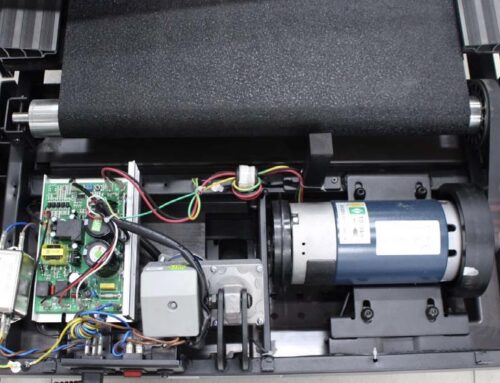
To inspect it, you’ll need to remove the motor hood — typically held in place by a few screws at the front of the machine. The drive belt wraps around the motor pulley and the front roller pulley. Look for glazing (a shiny, hardened surface), cracking, or visible fraying. A glazed drive belt loses its grip just like a worn tire and won’t respond to tension adjustments.
Drive belt replacement is well within the scope of a professional service call and is typically a fast, affordable repair. What it isn’t is a good DIY project if you’re unfamiliar with treadmill mechanics — the motor components involved are sensitive, and improper installation can create new problems.
Treadmill Belt Repair in Bucks County
If you’ve worked through the basics and the problem hasn’t resolved — or you’d simply rather have someone with decades of hands-on experience take a look — that’s exactly what we’re here for. At B.T. Fitness Equipment Repair Services, our owner Bart personally handles every service call throughout Bucks and Montgomery Counties. No subcontractors, no guesswork — just someone who has seen this exact problem more times than he can count and knows how to fix it right the first time.
Reliable treadmill belt repair in Bucks County is possible with B.T. Fitness Equipment Repair. Whether the issue is tension, lubrication, a worn running belt, or a failing drive belt, we diagnose it on-site and give you an honest assessment of what it needs — including whether a repair makes more financial sense than a replacement. We don’t upsell. We tell you what’s true.
We also offer virtual repair sessions for $99 if you’re outside our in-person service area or just want to try solving it yourself with a 48-year pro walking you through every step. Our virtual success rate is nearly 95%. Contact us today to repair your treadmill belt in Bucks County.